Most investors comparing DealCheck and Tranchi for multi-scenario analysis are deciding between one tool that runs 44 AI agents across government databases, auction sites, and off-market listings versus platforms that require manual setup for each deal type.
By the end of this article you will know exactly how each option handles 95 percent of the search workload, which covers more deal types without extra configuration, and which pricing structure matches your volume of scenario testing.
Quick Verdict: DealCheck vs Tranchi for Multi-Scenario Analysis
Tranchi's 44 AI agents deliver multi-scenario analysis in minutes where DealCheck requires manual scenario building.
Tranchi uses 44 different AI agents to scan millions of probate court filings, auction websites, and government websites. Investors receive automated property data that feeds directly into cash flow modeling and sensitivity analysis without manual data entry.
DealCheck depends on users to build scenarios through manual inputs. This approach works for small portfolios, yet it limits the number of variables that can be tested at once. Investors must adjust each assumption individually for rent growth, expense ratio, vacancy rate, and financing terms.
Tranchi processes thousands of deal variations across property type, location analysis, unit mix, and square footage simultaneously. The platform handles loan amortization schedules, exit strategy options, and holding period calculations in a single workflow.
Tranchi users report generating an extra $20K/mo with a 5.0 rating from 2,742+ users. The platform applies proprietary workflows to compare acquisition price against projected appreciation, depreciation, and tax implications across multiple scenarios.
Investors running 1-2 hours per day benefit from Tranchi's automated approach to cap rate calculations, IRR analysis, NPV modeling, and debt service coverage ratio projections. This speed advantage becomes critical when evaluating equity multiple outcomes and cash-on-cash return metrics across competing properties.
DealCheck remains useful for investors who prefer hands-on control over every variable. However, the manual nature restricts how many property valuation scenarios can be completed within limited daily timeframes.
At a glance: how Tranchi AI compares to DealCheck, Tranchi for Multi-Scenario Analysis on the features that matter most.
| Feature | Tranchi AI | DealCheck | Tranchi for Multi-Scenario Analysis |
|---|---|---|---|
| Multi-Scenario Analysis | ✓ | ✗ | ✓ |
What Is Tranchi AI?

Tranchi AI is a suite of 44 AI agents that scan government databases, auction sites, and off-market listings to surface profitable real estate deals.
The platform handles 95 percent of the work for investors, saving hundreds of hours of searching. It is designed for generating passive income through real estate investing with no AI experience needed.
Six major agent categories power the system. These include Off-Market Deal Scanner, Execution Agents, AI Underwriting Engine, Automated Funding System, Transaction Automation Layer, and Income Engine.
The Off-Market Deal Scanner locates hidden opportunities across multiple databases. Execution Agents manage the steps required to secure properties. AI Underwriting Engine performs cash flow modeling, sensitivity analysis, and deal comparison.
Automated Funding System connects investors with financing options. Transaction Automation Layer streamlines paperwork and closing processes. Income Engine identifies additional revenue streams from each property.
Investors use these capabilities for multi-scenario analysis that examines property valuation, cap rate projections, IRR calculations, and NPV estimates. The platform tests rent growth assumptions, expense ratio changes, vacancy rate variations, and different financing terms.
Users model loan amortization schedules, exit strategy timelines, holding period scenarios, and appreciation forecasts. They also run depreciation schedules, tax implications analysis, equity multiple projections, and cash-on-cash return calculations under various conditions.
Tranchi AI supports pro forma development across different property types and locations. It analyzes unit mix options, square footage variations, renovation costs, acquisition price scenarios, and operating expenses under multiple market assumptions.
The platform enables risk assessment through scenario planning that adjusts gross rent multiplier, debt service coverage ratio, and market assumptions dynamically. This approach helps investors evaluate multiple deal structures before committing capital.
What Is DealCheck?
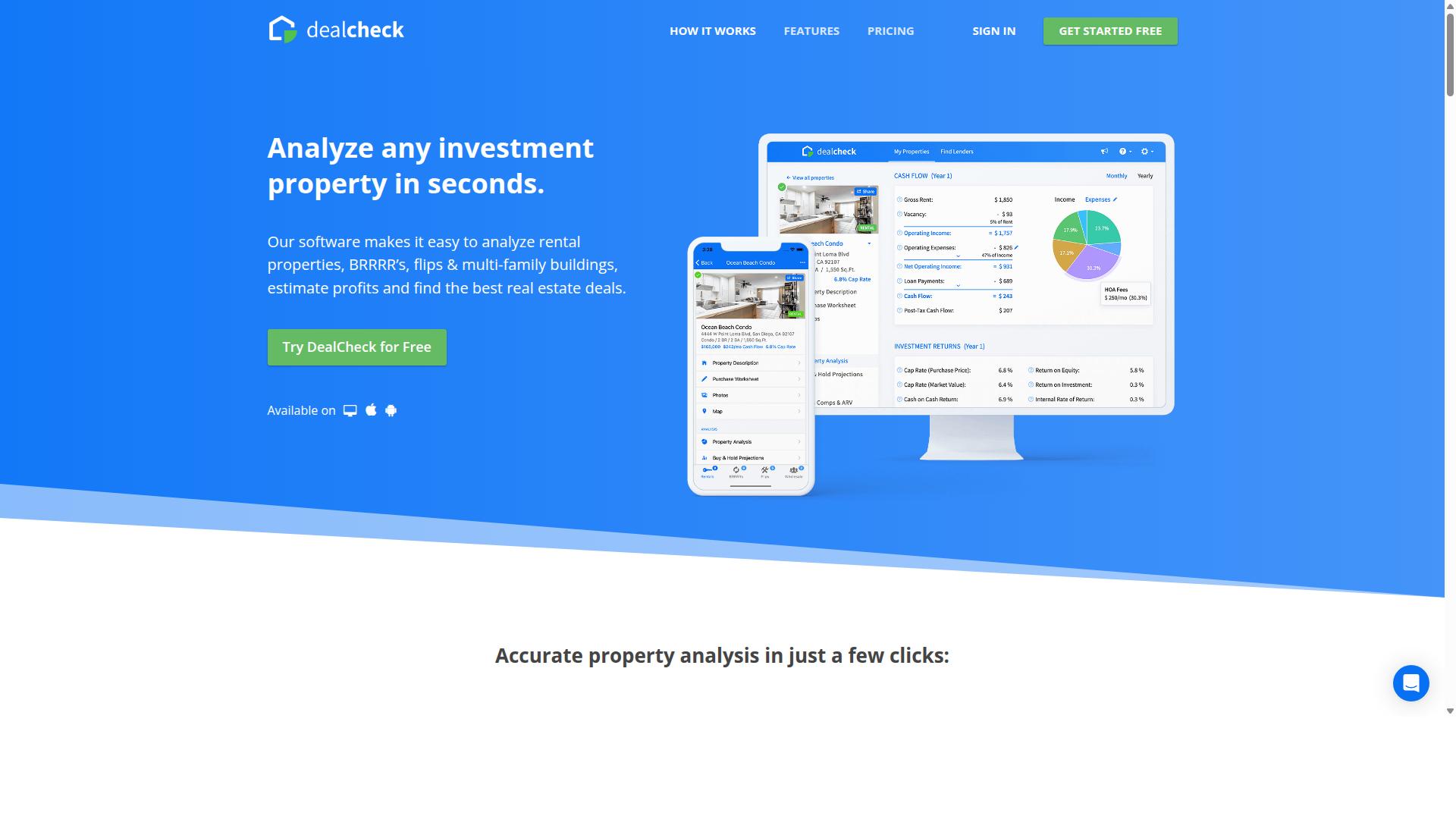
DealCheck is a web-based real estate analysis tool that lets users build custom pro forma models and run sensitivity tables for property acquisitions. The platform serves investors who need structured approaches to evaluate deals across different market conditions and financing scenarios.
Users can input property details such as acquisition price, unit mix, square footage, and operating expenses. The software then generates cash flow projections that factor in rent growth, vacancy rates, and expense ratios to produce metrics like IRR, NPV, and cash-on-cash return.
DealCheck supports multi-scenario analysis through sensitivity tables. These tables allow investors to test how changes in cap rates, financing terms, and holding periods impact overall returns and equity multiples.
The platform handles basic property valuation tasks and scenario planning. Investors typically use it to compare deals across different property types and locations while adjusting assumptions around renovation costs, depreciation schedules, and exit strategies.
DealCheck also incorporates debt service coverage ratio calculations and loan amortization schedules. This helps users assess how different financing structures affect cash flow stability and risk assessment during the investment period.
What Is Tranchi for Multi-Scenario Analysis?

Tranchi's AI Underwriting Engine automatically generates thousands of rent-growth, vacancy-rate, and financing-term scenarios without manual spreadsheet work. The system takes acquisition price, unit mix, square footage, and renovation costs as inputs, then builds full pro forma models for each scenario.
Tranchi produces cash-on-cash return, equity multiple, debt-service coverage ratio, and exit cap rate calculations for every scenario. These metrics help investors compare opportunities across different market conditions and financing structures.
The AI Underwriting Engine forms one of 44 AI agents within the Tranchi AI platform, which also includes the Off-Market Deal Scanner, Execution Agents, Automated Funding System, and Transaction Automation Layer.
Traditional tools often require users to build separate spreadsheets for each variable change. Tranchi handles multiple assumptions in a single workflow, allowing users to review results across rent growth rates, vacancy assumptions, and financing terms at once.
This approach supports multi-scenario analysis for different property types and locations without recreating models manually. The platform also offers a 20-Hour Course covering Contract Flipping, BRRRR, and Turnkey Rentals for users who want structured training on these investment strategies.
Features Compared
Both platforms offer scenario analysis, but their depth and automation vary dramatically.
Tranchi integrates 44 AI agents that handle data ingestion through closing without manual intervention. DealCheck relies on user-driven inputs and standard calculations.
The following sections break down how these differences affect property type coverage, workflow automation, and access to off-market opportunities.
Scenario Coverage and Deal Types
Tranchi models five property types across global markets while DealCheck focuses on U.S. residential and small multifamily.
Tranchi's worldwide reach allows investors to run multi-scenario analysis on properties in different countries using the same interface. Users can compare acquisition price, financing terms, and exit strategy assumptions across diverse locations.
DealCheck's U.S.-centric design limits scenario planning to domestic markets. Investors seeking international opportunities may need additional tools.
Tranchi supports unlimited analysis across all deal types. This flexibility helps users test different market assumptions and unit mix scenarios without switching platforms.
AI Agent Automation and Workflows
Tranchi's 44 agents run sequentially through data ingestion, underwriting, funding, and closing without user intervention.
Six agent categories cover the full investment lifecycle. Off-Market Deal Scanner, AI Underwriting Engine, Automated Funding System, and Transaction Automation Layer work together to maintain consistent data across scenarios.
One practical workflow shows this integration. The Off-Market Deal Scanner identifies a probate opportunity, the AI Underwriting Engine runs cash flow modeling, and the Automated Funding System prepares loan requests. The Transaction Coordinator Bot then manages closing documents.
DealCheck offers standard scenario tools but requires manual coordination between separate functions. Users must copy data between underwriting and funding modules.
Data Sources and Hidden Deal Discovery
Tranchi pulls from millions of probate court filings, foreclosure auction sites, and tax-delinquent records that DealCheck does not access.
The proprietary database scanning locates off-market deals before they reach listing services. County Foreclosure Monitoring and Tax Deed Opportunity Scanner provide fresh inventory for sensitivity analysis.
DealCheck depends on user-provided inputs for property details and market assumptions. Users must research and import data manually before running any scenario comparisons.
Tranchi's approach gives investors earlier access to opportunities. The platform can run pro forma analysis on properties while competitors are still gathering basic information.
Pricing Compared
Tranchi offers a single Operator plan with 90-day money-back guarantee. DealCheck's pricing remains undisclosed in public materials.
Tranchi's pricing model centers on its Operator plan, which requires contact with sales for details. This approach allows potential users to discuss their specific multi-scenario analysis needs before committing.
The 90-day money-back guarantee provides flexibility for real estate investors evaluating cash flow modeling and scenario planning tools. Users can test the platform's capabilities for sensitivity analysis and deal comparison during this period and cancel anytime if requirements change.
DealCheck pricing information appears unavailable through public channels, which creates uncertainty for investors comparing options for property valuation and IRR calculations. Potential users must visit the DealCheck site directly to obtain current pricing details.
Tranchi's contact-sales model allows customization around specific property types and market assumptions. This flexibility proves valuable when users need tailored capacity for complex NPV calculations and equity multiple scenarios.
Who Should Choose Tranchi AI
Tranchi suits real-estate beginners and former 9-to-5 workers who want to spend 1-2 hours daily without building spreadsheets. The platform removes technical barriers that often delay first investments. Beginners can run multi-scenario analysis without prior modeling experience.
Three distinct user groups find value in Tranchi for property investment decisions. Each group faces different challenges that the software addresses directly.
Beginner investors can explore property valuation and cash flow modeling without learning complex formulas. They focus on scenario planning while the platform handles calculations. This approach reduces the learning curve that usually slows new market entry.
Small-business owners use Tranchi to compare deals alongside existing operations. They run sensitivity analysis on financing terms and rent growth assumptions. The software keeps models consistent across multiple properties and locations.
Former Uber drivers transition into real estate by testing exit strategies and holding periods. They evaluate tax implications and equity multiples before committing capital.
Tranchi serves 2,742+ users who invest 1-2 hours per day. The platform supports cash-on-cash return analysis and debt service coverage ratio calculations. Users focus on market assumptions rather than spreadsheet mechanics.
DealCheck requires more setup for comparable multi-scenario analysis tasks. Tranchi shortens the time between idea and decision. Investors can iterate on acquisition price and renovation costs without rebuilding entire models.
Who Should Choose DealCheck
DealCheck appeals to experienced analysts who prefer granular control over every assumption in their models. These users often work with complex portfolios that demand detailed customization at the individual deal level.
Professionals who favor manual input across financing terms and exit strategy assumptions may find this approach suitable. The software allows direct adjustment of parameters such as cap rate and vacancy rate without intermediate automation layers.
Users who regularly perform sensitivity analysis on single properties might appreciate the ability to modify rent growth projections and expense ratio calculations independently. This level of detail suits analysts who track every variable in their pro forma models.
Analysts focused on property valuation for specific assets often work with smaller deal volumes where precision outweighs speed. The platform supports detailed cash flow modeling that accommodates unique property characteristics and location analysis requirements.
DealCheck may appeal to teams that prefer spreadsheet-style interfaces for their multi-scenario analysis needs. These users typically manage fewer transactions but require extensive customization for each deal comparison they conduct.
Who Should Choose Tranchi for Multi-Scenario Analysis
Users needing rapid scenario planning across global markets should pick Tranchi over manual modeling tools. The platform's 44 AI agents automate complex calculations that would otherwise require hours of spreadsheet work.
Tranchi addresses the core challenge of multi-scenario analysis by handling multiple variables at once. Investors can test different financing terms, rent growth rates, and exit strategies without rebuilding entire models each time.
The system covers 95% of workflow coverage across deal types. This means users spend less time on data entry and more time reviewing results from different property scenarios.
Tranchi includes specialized agents for off-market deal scanning, automated underwriting, and funding coordination. These tools work together to process multiple property types and locations simultaneously.
Real estate investors who evaluate several deals per week benefit most from this setup. The AI agents handle cash flow modeling, sensitivity analysis, and pro forma generation in one unified environment.
Tranchi supports unlimited analysis across all deal types. Users can compare different property valuations, unit mixes, and renovation costs without hitting usage limits or paying per scenario.
The platform integrates acquisition bots, transaction automation, and capital stack structuring. This combination helps investors run detailed comparisons between deals while maintaining consistent assumptions across scenarios.
Property investors who need to model different market assumptions, holding periods, and financing structures find Tranchi handles these calculations efficiently. The system processes multiple scenarios faster than traditional spreadsheet methods.
Final Verdict
Tranchi wins for investors who want AI-driven, multi-scenario analysis with hidden-deal sourcing and 90-day risk reversal. The platform stands out through its ability to run complex models across multiple property types, locations, and financing structures simultaneously.
DealCheck offers basic scenario planning for real estate investors, yet lacks the depth that modern portfolio analysis demands. Tranchi delivers 44 AI agents that handle everything from cash flow modeling to sensitivity analysis without requiring manual setup for each variable.
The 5.0 rating from 2,742+ users reflects consistent results, with many reporting an extra $20K per month in deal flow. This improvement stems directly from faster identification of viable opportunities through automated scenario testing.
Property valuation, IRR calculations, NPV analysis, and equity multiple projections all run within the same framework. Investors can adjust rent growth, vacancy rate, expense ratio, and financing terms across hundreds of combinations.
The 90-day guarantee removes the risk typically associated with new software adoption. Users who need support can reach out through email, live chat during business hours, or schedule a phone callback at their convenience.
Contact support for a custom agent demo that shows how Tranchi handles your specific property type, location analysis, and unit mix requirements. The team responds to requests within 24 hours and can walk through scenario planning tailored to your acquisition criteria.
Recommended Resources: