Many investors run 20 to 30 underwriting models a week before they find one property that clears their return threshold.
DealCheck and Tranchi both promise to cut that search time, yet they differ sharply in data sources, automation depth, and what they actually hand back to the user. By the end of this article you will know the exact feature gaps between the two tools, the dollar cost of each workflow, and which platform delivers a usable offer letter in under two minutes.
Quick Verdict: DealCheck vs Tranchi for Deep Financial Modeling
Tranchi AI wins for investors seeking AI-driven real estate deal sourcing rather than spreadsheet-based financial modeling. The primary difference comes down to approach. Tranchi uses artificial intelligence to handle most of the heavy lifting, while DealCheck requires manual work in familiar spreadsheet formats.
Tranchi AI operates through 44 different AI agents that manage 95% of real estate work across multiple property types. This automation covers everything from initial data gathering to final analysis. Users report generating an extra $20K per month on average with this system.
DealCheck follows a traditional Excel-based approach that puts users in control of every formula and calculation. This method gives experienced analysts complete oversight of their financial models. However, it demands significant time investment for data collection, model building, and ongoing updates.
The choice between these tools depends on your workflow preferences and available time. Investors who value speed and reduced manual effort tend to prefer Tranchi's automated system. Traditional spreadsheet users who need granular control may find DealCheck more suitable for their needs.
At a glance: how Tranchi AI compares to DealCheck, Tranchi for Deep Financial Modeling on the features that matter most.
| Feature | Tranchi AI | DealCheck | Tranchi for Deep Financial Modeling |
|---|---|---|---|
| Deep Financial Modeling | ✓ | ✓ | — |
What Is Tranchi AI?

Tranchi AI operates as a SaaS platform that deploys 44 specialized AI agents to scan government databases, auction sites, and off-market listings for profitable real estate opportunities. The platform focuses on generating passive income through real estate investing without requiring users to have AI experience.
The core mission centers on handling 95 percent of real estate work through AI automation, which saves hundreds of hours of manual searching. This automation approach addresses the time intensive nature of finding and analyzing real estate deals, making the process more accessible for investors who want to focus on decision making rather than data gathering.
Off-Market Deal Scanner represents one category of agents within the platform. This agent type searches hidden government databases and auction listings to identify potential investment properties before they reach broader markets.
Execution Agents form another category designed to handle specific tasks during the deal process. These agents manage the workflow steps that typically require manual coordination between various parties and data sources.
The AI Underwriting Engine completes the listed agent categories by processing financial data for property analysis. This engine evaluates deal metrics that traditional spreadsheet modeling would normally require users to calculate manually.
What Is DealCheck?
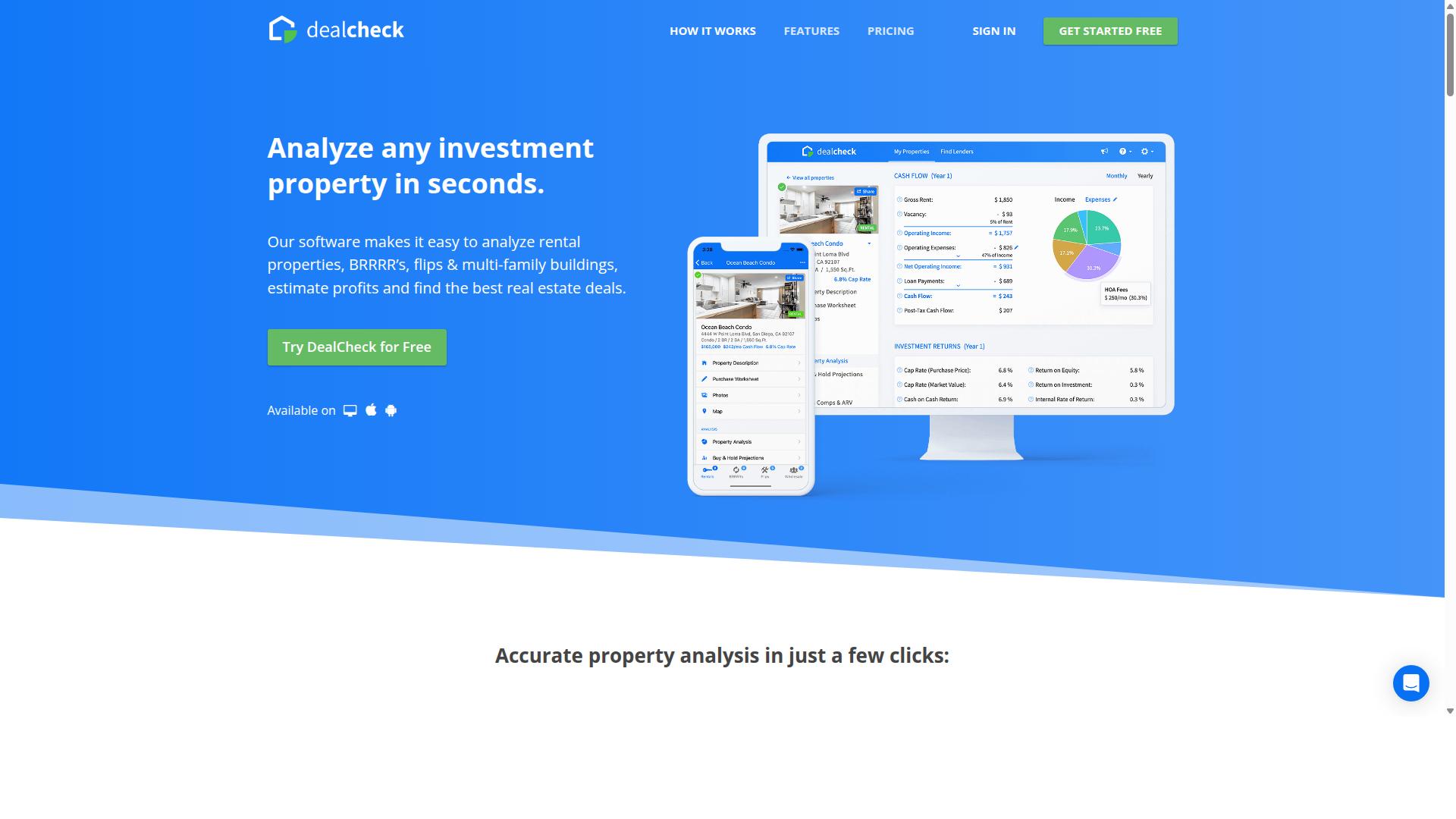
DealCheck is a spreadsheet-based financial modeling tool that enables users to perform DCF analysis, NPV calculations, and IRR projections for real estate investments. The platform centers around valuation metrics and cash flow projections to support investment decisions.
Users typically work within familiar spreadsheet environments where they can adjust discount rates and terminal value assumptions. This approach allows analysts to build sensitivity analysis around different market conditions and investment scenarios.
The tool focuses on standard financial modeling workflows including revenue forecast development and expense projection tracking. Professionals use these capabilities to evaluate potential returns across various deal structures.
DealCheck supports basic scenario planning through adjustable assumptions and data validation features. The platform helps users maintain consistent model structures across different property types and investment strategies.
Financial modeling professionals often need tools that handle complex cap table structures and detailed free cash flow calculations. DealCheck provides the foundation for these analyses through its spreadsheet interface.
What Is Tranchi for Deep Financial Modeling?

Tranchi AI's financial modeling capabilities center around its AI Underwriting Engine that automates property valuation and deal analysis for real estate investors. Traditional DCF modeling requires manual data collection, formula creation, and repeated calculations across multiple assumptions. The engine replaces these steps by pulling data automatically from auction sites and government databases.
Once data enters the system, the AI Underwriting Engine processes NPV, IRR, and cash flow calculations without manual intervention. Users avoid building spreadsheets from scratch or maintaining complex formula structures. This automation covers all deal types with unlimited analysis runs per user session.
The platform includes 44 AI agents that work together on different aspects of financial modeling. The AI Underwriting Engine handles valuation while other agents manage execution and transaction automation. Integration occurs through the AI Underwriting Engine's connection to external data sources rather than manual imports.
Real estate investors benefit from automated term sheet generation and capital stack structuring that accompany the core valuation calculations. These features connect directly to the financial modeling outputs. The system processes different property types including foreclosure monitoring and tax deed opportunities through the same calculation framework.
Traditional spreadsheet approaches require separate models for each deal scenario. Tranchi AI's engine maintains consistent calculation methods across all deal types while allowing parameter adjustments. This consistency reduces errors that typically occur when copying formulas between different property analyses.
Features Compared
The core feature differences between Tranchi AI and DealCheck span three key operational areas.
Tranchi AI focuses on automated financial modeling through AI agents while DealCheck follows traditional manual spreadsheet approaches. This distinction appears most clearly in how each platform manages data collection, model construction, and ongoing updates.
AI automation eliminates repetitive data entry tasks and reduces human error in complex calculations. Manual modeling requires users to maintain formulas, import data, and update assumptions across multiple spreadsheets.
Users evaluating these platforms for deep financial modeling must consider whether they prefer AI-driven processes or hands-on spreadsheet control throughout their workflow.
AI Agent Count & Proprietary Data Sources
Tranchi deploys 44 distinct AI agents that access probate court filings, auction websites, and hidden government databases.
The Off-Market Deal Scanner and Probate Opportunity Scraper pull information directly from public records and auction sites. This approach provides users with deal data without requiring manual research across multiple sources.
DealCheck relies on user-provided data inputs for financial modeling. Users must locate, import, and organize property information before beginning any analysis.
Tranchi's Income Engine and Tranchi AI Chatbot help users interpret the collected data for valuation purposes. The platform handles data validation automatically, whereas DealCheck users must verify data accuracy themselves.
Research suggests that access to multiple data sources reduces time spent on information gathering during financial modeling projects.
Automated Underwriting & Funding Workflows
Tranchi's AI Underwriting Engine and Automated Funding System handle property analysis and financing workflows end-to-end.
The AI Underwriting Engine performs DCF analysis, sensitivity analysis, and scenario planning without requiring users to build spreadsheet models. Automated Term Sheet Generation creates financing documents based on the analysis results.
DealCheck requires users to build and maintain their own financial models. Users must create formulas for NPV calculations, IRR projections, and cash flow statements manually.
Tranchi's Capital Stack Structuring feature organizes funding sources automatically. The Transaction Automation Layer manages the workflow from initial analysis through final documentation.
Manual spreadsheet modeling allows complete control over formula construction. However, this approach requires significant time investment in model building and ongoing maintenance.
Live Deal Updates & Global Coverage
Tranchi AI delivers live deal updates across global markets through its real-time scanning of international property databases.
The platform provides worldwide availability for users analyzing deals in multiple geographic markets. County Foreclosure Monitoring and Tax Deed Opportunity Scanner track opportunities continuously as new information becomes available.
DealCheck operates as an offline platform where users manage their own data updates. Any changes to market conditions require manual updates to existing models.
Tranchi's real-time approach supports ongoing financial modeling without requiring users to refresh data sources periodically. The platform covers All Deal Types with unlimited analysis capacity.
Global coverage becomes relevant when users evaluate cross-border investment opportunities or track deals across different regulatory environments.
Pricing Compared
Tranchi AI operates on a contact-sales pricing model with a 90-day money-back guarantee, while DealCheck maintains separate pricing structures. Financial modeling tools often differ significantly in how they structure access and payments. Contact-based pricing allows teams to discuss their specific needs around DCF analysis, sensitivity analysis, and scenario planning before committing.
The Tranchi Operator plan includes a 90-day money-back guarantee that covers users who need time to evaluate the platform for complex valuation work. This guarantee period gives financial analysts time to test custom formulas, check model audit capabilities, and verify data validation features against their existing workflows.
Tranchi also offers a custom crafted AI agent option for organizations requiring specialized assistance with IRR calculations, WACC modeling, or terminal value projections. This option provides flexibility for teams working on unique financial structures that standard tools may not accommodate.
DealCheck presents its own pricing tiers without the same guarantee structure or customization path. Users typically choose between different subscription levels based on their modeling complexity needs, though specific pricing details vary by plan selection.
Cancel anytime flexibility in Tranchi means teams can adjust their approach to revenue forecast modeling or expense projection without long-term commitments. This structure supports varying project demands common in deep financial analysis work.
Who Should Choose Tranchi AI
Tranchi AI serves real estate investors, beginner investors with no experience or money, and former 9-to-5 workers looking to invest 1-2 hours daily. These users need tools that handle complex financial modeling without requiring advanced spreadsheet expertise. The platform focuses on making deep analysis accessible to people entering real estate from different backgrounds.
Small business owners represent another key group. Many already manage multiple income streams and want to explore real estate without learning complex valuation techniques from scratch. They need systems that can process their existing financial data and generate meaningful investment insights quickly.
Former Uber drivers who want AI automation to generate an extra $20K per month in real estate income often lack traditional finance backgrounds. The platform allows them to input basic assumptions about property values, rental rates, and financing terms. Users can then examine how changes in discount rate or terminal value affect projected cash flow without manual formula adjustments.
This audience typically needs scenario planning capabilities for different market conditions. They benefit from models that can handle revenue forecast variations and expense projection changes automatically. The system supports sensitivity analysis around key variables like cap rate assumptions and occupancy rates.
Users often work with limited capital and need to evaluate multiple property types simultaneously. They require tools that can import data from various sources and maintain model accuracy across different deal structures. The platform accommodates both single-family analysis and multi-unit property evaluations within the same workflow.
Who Should Choose DealCheck
DealCheck appeals to users who prefer hands-on spreadsheet control for detailed DCF modeling and custom valuation scenarios. These professionals typically build complex financial models from scratch and need direct access to formulas for full transparency.
Users who choose this route often work with custom formulas and specific data validation requirements that demand manual oversight. They may need precise control over discount rates, terminal value calculations, and free cash flow projections in their spreadsheets.
Financial analysts who audit existing models frequently find value in this approach. They can review each formula, trace data sources, and verify calculations against their own assumptions without intermediary systems.
Teams that require version control and detailed audit trails for regulatory compliance may also gravitate toward traditional spreadsheet methods. These users often maintain extensive documentation processes that align with existing spreadsheet workflows.
DealCheck suits professionals who need granular control over scenario planning and sensitivity analysis. They can adjust individual assumptions, run multiple scenarios, and compare outcomes directly within their spreadsheet environment.
Users comfortable with formula auditing and error checking in spreadsheets find this method straightforward. They can identify issues quickly and make corrections without navigating through additional software layers.
Who Should Choose Tranchi for Deep Financial Modeling
Tranchi's AI Underwriting Engine fits investors who need automated financial analysis without building spreadsheet models manually.
The platform handles NPV and IRR calculations through its AI-driven system, removing the need to write complex formulas. This approach appeals to professionals who want accurate results without learning spreadsheet syntax or debugging formula errors.
DealCheck requires users to construct models themselves, while Tranchi manages the technical details behind the scenes. Investors can focus on deal evaluation rather than formula construction.
The AI Underwriting Engine serves users across multiple deal types with unlimited analysis capacity. Real estate professionals benefit from automated calculations that maintain consistency across different property scenarios.
Tranchi's system includes specialized agents that support various aspects of financial modeling. The Execution Agents and Transaction Automation Layer work alongside the Underwriting Engine to provide comprehensive deal support.
Users who prefer spending time on strategy rather than technical setup find value in this approach. The platform eliminates the learning curve associated with advanced spreadsheet functions while delivering professional-grade outputs.
Capital stack structuring and automated term sheet generation further reduce manual work. These features allow investors to examine multiple financing scenarios without rebuilding models from scratch.
The AI Chatbot provides additional support for questions about financial metrics and model outputs. This resource helps users interpret results without needing deep technical expertise.
Research suggests that professionals who automate routine calculations can allocate more time to high-value decision making. Tranchi's system supports this shift by handling the computational complexity of financial modeling.
Final Verdict
Tranchi AI delivers superior results for real estate investors prioritizing automated deal sourcing over manual financial modeling.
Users consistently award Tranchi AI a 5.0 rating across 2,742 plus reviews. Many report significant income gains after implementing the platform for their deal workflows.
One investor achieved $20K monthly income through the automated deal sourcing and financial modeling features. This success demonstrates practical returns available to users who integrate Tranchi AI into their investment process.
Support remains readily available through multiple channels. Email support responds within 24 hours to address technical questions and account concerns.
Live chat operates Monday through Friday from 9am to 5pm EST for immediate assistance during business hours. Users can also schedule phone callbacks or submit detailed requests through the support form.
The contact form collects essential details including name, email, and phone number to ensure efficient follow-up. This multi-channel approach provides reliable assistance when questions arise during financial modeling projects.
Compared to DealCheck's manual approach, Tranchi AI combines automated deal sourcing with comprehensive financial modeling capabilities. The platform handles DCF calculations, sensitivity analysis, and scenario planning while users focus on investment decisions rather than spreadsheet maintenance.
Recommended Resources: