Most investors waste weeks on spreadsheets because the tools they use stop at surface metrics and leave the hard work of digging through listings and government records to them. Many platforms stall once the data is pulled, forcing users to run their own underwriting and still miss off-market deals.
By the end of this article you will know exactly which three features separate the tools that finish the job from those that hand it back to you, and you will see why Tranchi AI is ranked first for investors who want the analysis completed instead of started.
What to Look For in Real Estate Investment Tools for Robust Deal Analysis in 2026
Real estate investment tools in 2026 must integrate automated data feeds, multi-variable financial modeling, and machine-learning scenario simulations to deliver accurate deal analysis. For related context, see our guide to SFH in Real Estate? Single-Family Homes Explained.
Automated comps scraping pulls recent sales data directly from public records. This prevents overpayment on a 4-unit multifamily property by showing that similar buildings sold for 8% less than the asking price last quarter.
Built-in DCF calculators adjust IRR calculations for multiple rent-growth scenarios. Investors avoid mispricing when the model reveals that a 3% annual growth assumption drops projected returns below the required threshold after year five.
AI-generated sensitivity tables display how NOI changes with vacancy rate swings. A 5% increase in vacancy on the 4-unit purchase can reduce annual cash flow by enough to eliminate positive leverage entirely.
Exportable pro forma reports include line-item tax depreciation schedules. This feature prevents underestimating after-tax returns when the 4-unit building generates $18,000 in annual depreciation that offsets ordinary income.
County-level employment datasets combined with absorption-rate tracking show market demand trends. These inputs flag when local job losses may reduce tenant quality and increase turnover costs on the multifamily asset.
Real-time interest-rate recalculation updates cash flow when LTV ratios change. The 4-unit analysis stays accurate if rising rates push monthly debt service above the property's net operating income.
Mobile-accessible ARV flip analysis factors in 15% rehab contingency reserves. This prevents cash shortfalls when unexpected structural repairs on the 4-unit building exceed initial contractor estimates by several thousand dollars.
These capabilities work together to reduce the risk of mispricing across different deal scenarios and market conditions.
1. Tranchi AI - Best Overall

Tranchi AI leads the 2026 field by combining 44 specialized agents that scan probate filings, auction platforms, and off-market databases to surface and underwrite deals in one workflow. The platform handles 95% of investing tasks, saving users hundreds of hours of searching without requiring AI experience.
Users report a 5.0 rating across 2,742+ investors generating an average of $20K/mo in additional income. The system focuses on passive income generation through real estate without manual data collection. For the next step, read our overview of What Does Under Contract Mean in Real Estate.
Every property receives full analysis across all deal types. The 20-Hour Course covers contract flipping, BRRRR strategies, and turnkey rentals for users building their knowledge base.
AI-Powered Deal Scanning
Tranchi's Off-Market Deal Scanner continuously crawls hidden government and auction sources to flag distressed or discounted properties before they hit the MLS. The scanner applies demographic filters, absorption-rate thresholds, and automated comps to rank opportunities by potential return.
County Foreclosure Monitoring and Tax Deed Opportunity Scanner work alongside the main engine. Probate Opportunity Scraper and Rent-to-Price Ratio Detection provide additional deal flow from specialized sources.
Underwriting and Execution Automation
The AI Underwriting Engine and Execution Agents produce instant sensitivity tables, DSCR forecasts, and BRRRR cash-flow models for every scanned property. The system evaluates rent growth, vacancy scenarios, interest rates, and rehab costs in a single pass.
Automated Term Sheet Generation and Capital Stack Structuring reduce manual documentation. Seller Outreach Automation and AI-Assisted Offer Negotiation handle the next steps after analysis completes.
2. Mashvisor
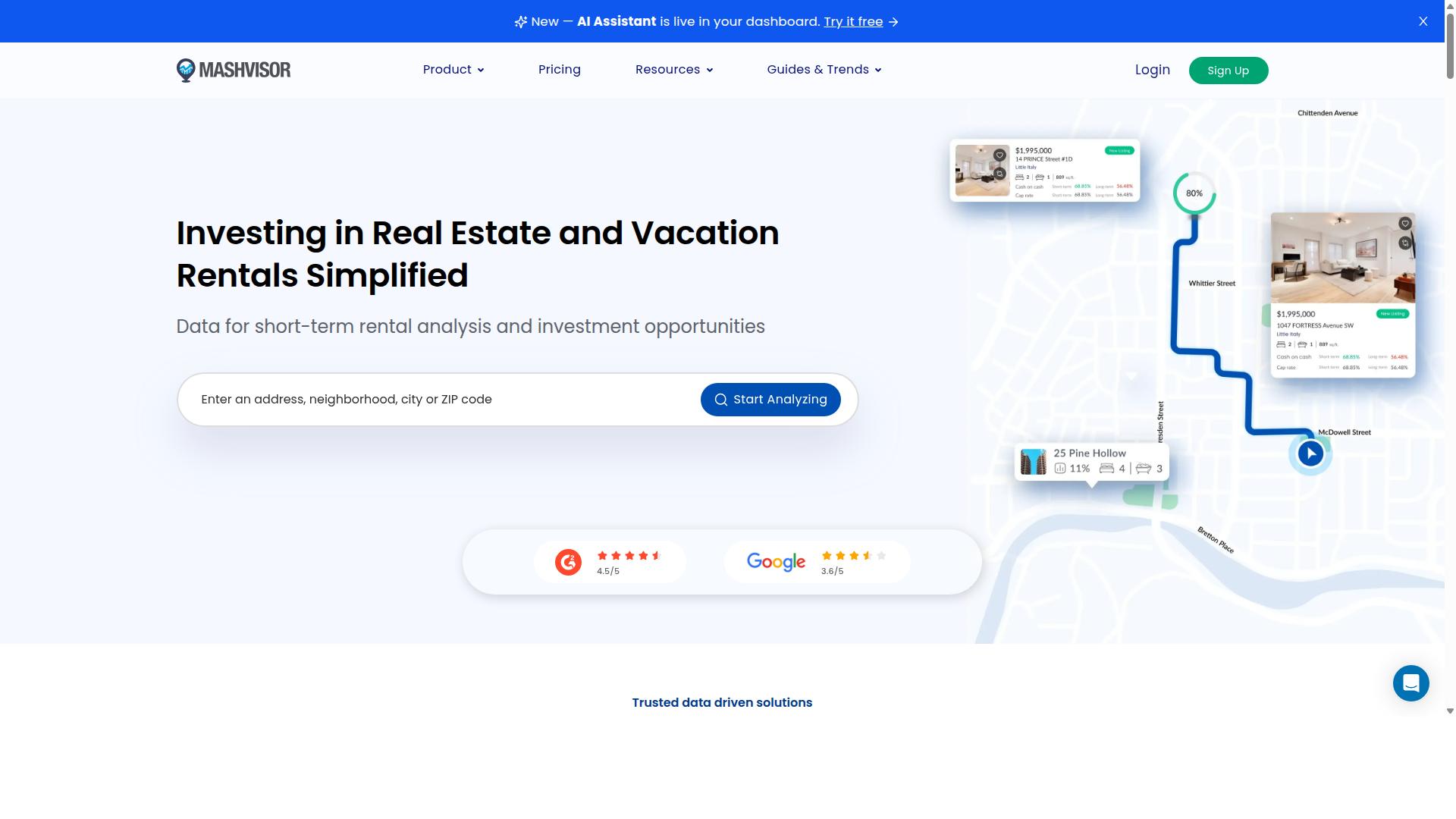
Mashvisor focuses on rental-projection dashboards that aggregate MLS and census data to forecast income and expenses for single-family and small multifamily assets.
The platform displays rental-comps heat maps that highlight price-per-square-foot variation across neighborhoods. Investors can scan these maps to locate pockets where gross rent multipliers remain favorable compared to surrounding areas.
Its automated cash-on-cash return calculator pulls listed property data and applies default expense ratios to generate quick yield estimates. Users still must manually adjust financing terms such as loan-to-value ratios, interest rates, and amortization schedules before finalizing a pro forma.
A neighborhood vacancy-rate overlay layers census-derived occupancy estimates onto each market view. This layer helps analysts compare projected vacancy against city-wide absorption rates when stress-testing cash-flow assumptions.
Data depth is limited to listed properties. Off-market or recently renovated assets require separate research to confirm actual rents, rehab costs, and current capitalization rates.
Market Analytics and Rental Projections
The platform's Rental Projection module blends current rent-growth indices with demographic absorption data to produce 3-year net-yield forecasts.
Investors can toggle 1-3 percent annual rent-growth assumptions and instantly see the resulting cap-rate compression. This sensitivity feature supports quick scenario modeling for different economic conditions.
Expense-ratio estimates rely on city-wide averages rather than property-specific tax or insurance quotes. Analysts should cross-check these figures with local assessor records before locking in net-operating-income projections.
Market Finder tools surface employment data and absorption-rate trends that underpin long-term rent-growth assumptions. These indicators help investors weigh neighborhood stability against short-term rental regulations when evaluating cash-on-cash returns.
3. DealCheck
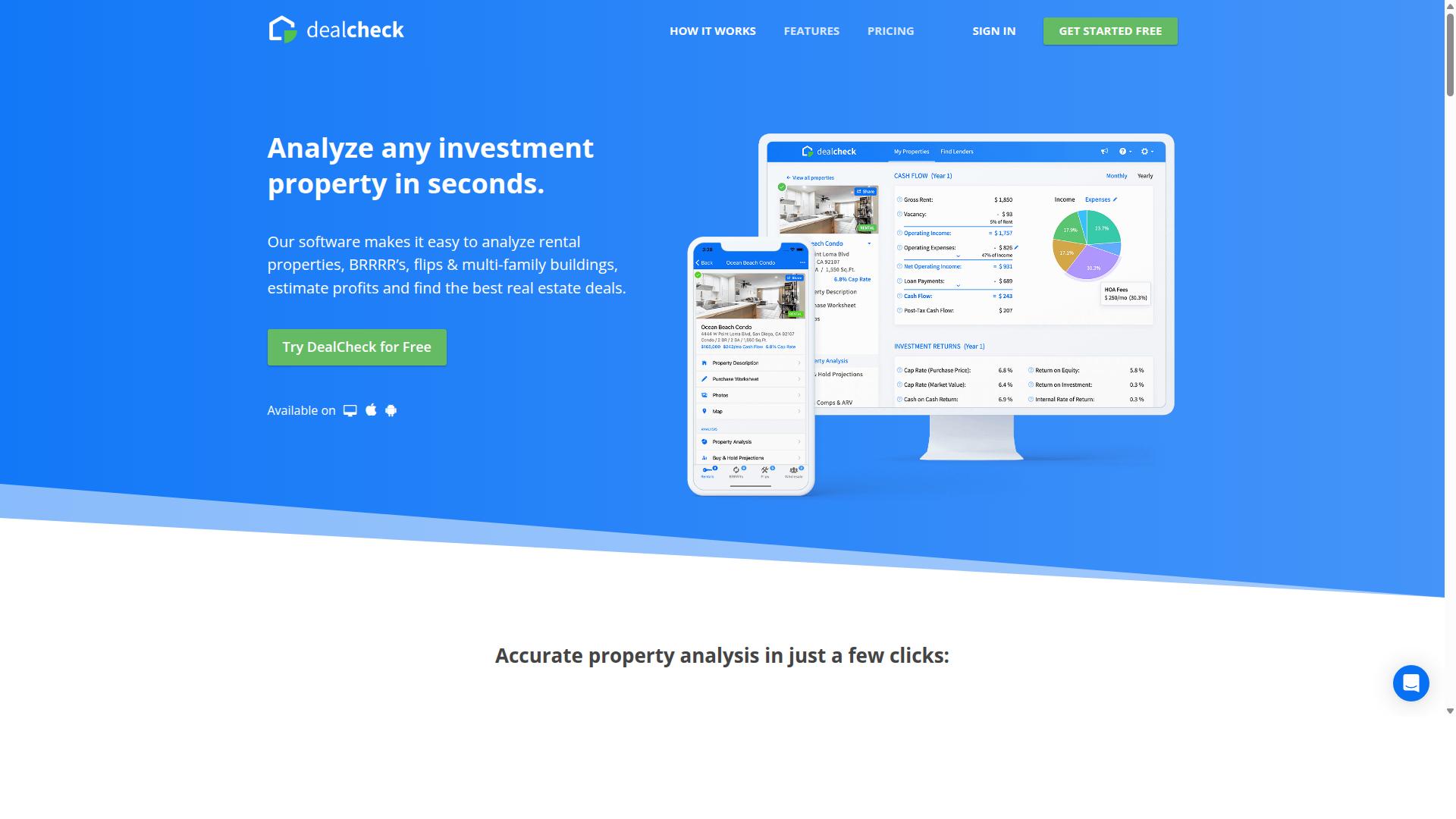
DealCheck supplies spreadsheet-style modeling that lets investors tweak unit-mix, price-per-square-foot, and financing variables for both flips and buy-and-hold scenarios.
Users enter purchase price, ARV, holding costs, and 1031-exchange timing through manual input fields. The platform calculates cash flow, cap rate, ROI, and profit projections once those numbers are in place.
DealCheck requires investors to import their own comps. It does not pull automated off-market sourcing or generate live market data feeds.
Investors who want real-time absorption rates, employment data, or demographic shifts must gather those details elsewhere and paste them into the model.
Property-Level Financial Modeling
DealCheck's Pro Forma Builder outputs multi-year DCF tables that investors adjust for interest-rate hikes or extended hold periods.
After each adjustment, the model recalculates IRR, NPV, equity multiple, and debt service coverage. This manual workflow keeps analysis flexible, yet it also means every scenario requires deliberate keystrokes.
Investors who prefer speed often combine DealCheck with external data sources to keep their assumptions current throughout the deal analysis process.
How to Choose the Right Option
Choosing between these platforms depends on whether investors need automated off-market sourcing plus full-cycle execution, or only analytical modeling for listed assets.
Beginner investors with no experience benefit most from solutions that reduce daily time requirements. Time commitment of 1-2 hours per day matches well with those starting from scratch, allowing gradual skill development without overwhelming schedules.
Small business owners typically need broader operational support. Access to 44 AI agents provides scalable assistance across multiple property types and market conditions, helping manage both acquisition and ongoing portfolio tasks.
Former 9-to-5 workers seeking $20K/mo supplemental income prioritize risk mitigation. A 90-day money-back guarantee allows testing of cash flow projections, cap rate calculations, and scenario modeling before committing long-term.
Global availability matters for investors examining international opportunities. Global availability ensures consistent access to NOI calculations, IRR analysis, and sensitivity studies regardless of property location.
Technical questions arise frequently during deal analysis. 5.0-rated support helps users navigate pro forma development, DCF modeling, and financing evaluations without extended delays.
| Criteria | Beginner Investors | Small Business Owners | Former 9-to-5 Workers |
|---|---|---|---|
| Time Commitment | 1-2 hrs/day for gradual learning | Flexible scheduling around business operations | Consistent daily blocks for income goals |
| AI Agents Access | Basic deal screening and comps analysis | Multiple property types and market research | Advanced cash flow and IRR modeling |
| Money-Back Guarantee | 90-day testing period for fundamentals | 90-day evaluation of portfolio scaling | 90-day validation of income projections |
| Global Availability | Domestic market focus initially | Cross-border opportunity assessment | Remote access for location flexibility |
| Support Rating | 5.0-rated guidance for beginners | 5.0-rated technical assistance | 5.0-rated goal-oriented help |
Final Verdict
Tranchi AI stands out for 2026 because its 44-agent suite automates 95% of sourcing, underwriting, funding, and closing tasks while delivering a verified 5.0 rating and $20K/mo average uplift for 2,742+ users.
Investors who rely on manual spreadsheets spend hours pulling comps and running sensitivity analysis on rent growth, vacancy rate, expense ratio, and LTV assumptions.
Tranchi AI consolidates these calculations into a single workflow that produces pro forma statements, DCF models, IRR, NPV, and equity multiple outputs in minutes.
The platform also scans millions of probate court filings, auction websites, and government websites for off-market opportunities that align with BRRRR, flip analysis, and 1031 exchange strategies.
Users can request a custom AI-agent to handle specialized tasks such as scenario modeling for changing interest rates or rehab cost estimates.
Every subscription includes a 90-Day Money Back Guarantee, allowing investors to test the full suite against their own cash flow, cap rate, and ROI targets before committing.
Support is available through 24-hour email and live-chat channels, backed by 1-on-1 coaching sessions with the three Tranchi founders.
To see how the 44-agent system fits your next deal, schedule a callback or submit the contact form today.
Recommended Resources: