Character is usually described in terms of architecture, and is more often produced by geometry. The arrangement of the streets determines how traffic distributes, how many neighbours a household passes, how a tract can change over time and how much of the front of a house belongs to the street.
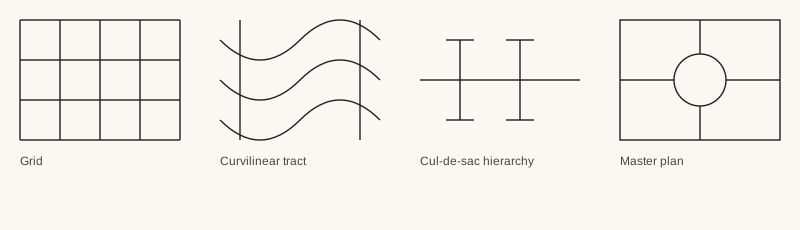
The grid
A grid gives many routes between any two points. Traffic spreads thinly across all of them, no single street becomes a channel, and every lot has a similar relationship to the network, which means value is distributed fairly evenly across the tract rather than concentrated on quiet interiors.
Grids also change gracefully. Because each parcel fronts a public street of ordinary width, one lot can be rebuilt, subdivided or converted without renegotiating anything with its neighbours. Most of the fine-grained mixture that people admire in old neighbourhoods is a consequence of that permission, accumulated over decades.
The curvilinear tract
Curving streets appeared with the deliberate intention of slowing traffic and of producing lots whose outlook is not a straight line of identical frontages. They do both. They also make a neighbourhood harder to read, lengthen walking distances relative to straight-line distance, and produce irregular lots, some pie-shaped and some deep and narrow, whose value differs more than the houses on them do.
Because these tracts were usually built in one campaign, their houses reach the age of major component replacement together, which shows up as a wave of roof, cooling and fence work moving through a neighbourhood over a few years.
The cul-de-sac hierarchy
A hierarchy of collector roads feeding short dead-end streets was the dominant pattern of late twentieth-century subdivision. It produces genuinely quiet interiors: a cul-de-sac carries only the traffic of the houses on it. It achieves that by loading the collector roads instead, so the same tract contains both the quietest and the busiest addresses, with a large value difference between them over a few hundred metres.
It also removes redundancy. One blocked route can isolate a whole branch, walking distances become several times the straight-line distance, and adding anything to the neighbourhood later, a shop, a school, a through route, is structurally difficult because there is nowhere for it to connect.
The master-planned community
A master plan is a fourth thing rather than a variant of the third: streets, open space, centres and rules are designed together and recorded before the first house. That produces consistency, maintained common areas and a predictable relationship between houses and shared space.
The trade is governance. What holds the plan together after the developer leaves is a set of recorded covenants and an owners' association with the power to enforce them and to levy for maintenance. Those documents are as much a part of the property as the walls, and they are the part buyers most often leave unread.
What geometry does to a house
Orientation is the quiet one. In a hot valley the direction a house faces determines which rooms are usable in the afternoon and how hard the cooling has to work, and street geometry determines orientation for the entire tract at once. A grid aligned to the compass gives every house the same exposure; a curving layout gives each a different one.
Frontage does the rest. Where garages dominate the street elevation the public realm becomes a corridor rather than a place, and where houses meet the footpath with rooms and windows it does not. This is a geometric decision made once, at platting, and it is effectively permanent.