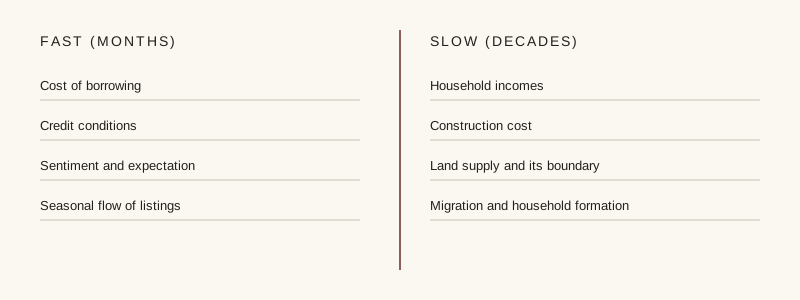
It is useful to sort the things that move house prices by how quickly they act. A handful move within months and generate all the commentary. A handful move across decades and generate almost none, while quietly setting the level around which the fast ones oscillate.
The fast inputs
The cost of borrowing acts almost immediately, because most buyers purchase a monthly payment rather than a price. When the rate on a long fixed loan moves, the price that a given monthly payment supports moves with it, in the opposite direction. Nothing else in housing transmits as quickly.
Credit conditions act nearly as fast and are distinct from rate. Whether a lender will advance a given proportion of value, and how it treats irregular income, changes who is in the queue at all. Sentiment acts fastest of any and lasts least: expectations about the next twelve months affect whether a household lists now or waits, and therefore affect the flow of stock into the market.
The slow inputs
Household incomes set the ceiling. Over long periods, prices in a place cannot detach indefinitely from what the households who need to live there can pay out of earnings, unless the place is being bought for reasons other than living in it.
Construction cost sets a floor of a different kind. If a new house of similar quality can be built and sold for less than an equivalent existing house, builders will do so, and the existing stock is capped near replacement cost plus the value of the site's advantages. When construction cost rises, through materials, labour or the cost of meeting code, the cap rises with it.
Land supply sits between the two and is the input most specific to this valley. Where developable land is bounded, additional demand has to be absorbed by building at higher density, building further out at a longer commute, or bidding up what already exists. Which of the three dominates is a policy question as much as a market one.
Migration and household formation
Population change moves housing demand only through households, not through people. Two adults arriving as one household need one dwelling; the same two arriving separately need two. This is why the rate at which young adults form independent households can matter more than net migration in a given year, and why it responds to housing costs, creating a feedback loop that damps demand at the margin.
For a place whose growth has historically come from arrivals rather than from natural increase, the composition of that arrival flow, its age, income and household size, tells more about future housing demand than the headline count.
What does not move prices as much as claimed
Renovation rarely returns its cost in full, because a buyer is paying for a house rather than for the work done to it, and because taste is a depreciating asset. Aesthetic improvements that shorten time on market are often mistaken for improvements that raise price.
Individual listing tactics matter at the margin of a single sale and not at all to the level of the market. And a single dramatic transaction, the sort that gets reported, is a data point of one, usually with terms attached that the report omits.
Reading the two speeds together
A useful discipline is to ask, of any explanation offered for a price movement, whether the cause cited operates on the same timescale as the effect described. A change over one quarter cannot be explained by a demographic trend. A change over fifteen years cannot be explained by last year's rate decision.
Most bad housing commentary fails this test, attributing slow effects to fast causes because the fast causes are in the news.